How to Calculate Mobile Game Payback Period: A Worked Example
Calculate mobile game payback period from one campaign cohort, net revenue, and spend, then use the result for budget decisions.

A mobile game payback period tells a UA team when one cohort has returned the money spent to acquire it. It should use cumulative net revenue from the same installs and the same campaign cost, not blended revenue from the whole app. That makes the answer useful when deciding which campaign can take more budget.
What a mobile game payback period measures
Payback is the first day when cumulative net revenue from an acquired cohort equals or exceeds the spend that acquired it. The cohort needs a fixed start date, a campaign identifier, and a revenue definition that stays unchanged while the cohort ages.
For a game, net revenue should be the amount the business can count after the adjustments used in its finance reporting. That often means removing refunded purchases and other deductions before comparing revenue with paid media cost. The exact treatment should match the reporting policy used for every campaign in the comparison.
This differs from a blended ROAS report. Blended revenue can rise because of organic installs, old cohorts, or a successful campaign that did not fund the installs being measured. A cohort report asks a narrower question: did this specific spend return through the players it acquired?
Google describes target ROAS for App campaigns as a bidding approach based on conversion values for selected actions. The Google Ads App campaign bidding guide is a useful reminder to keep the conversion value definition consistent with the bid goal. A mobile game payback period adds the time dimension that a single ROAS percentage leaves out.
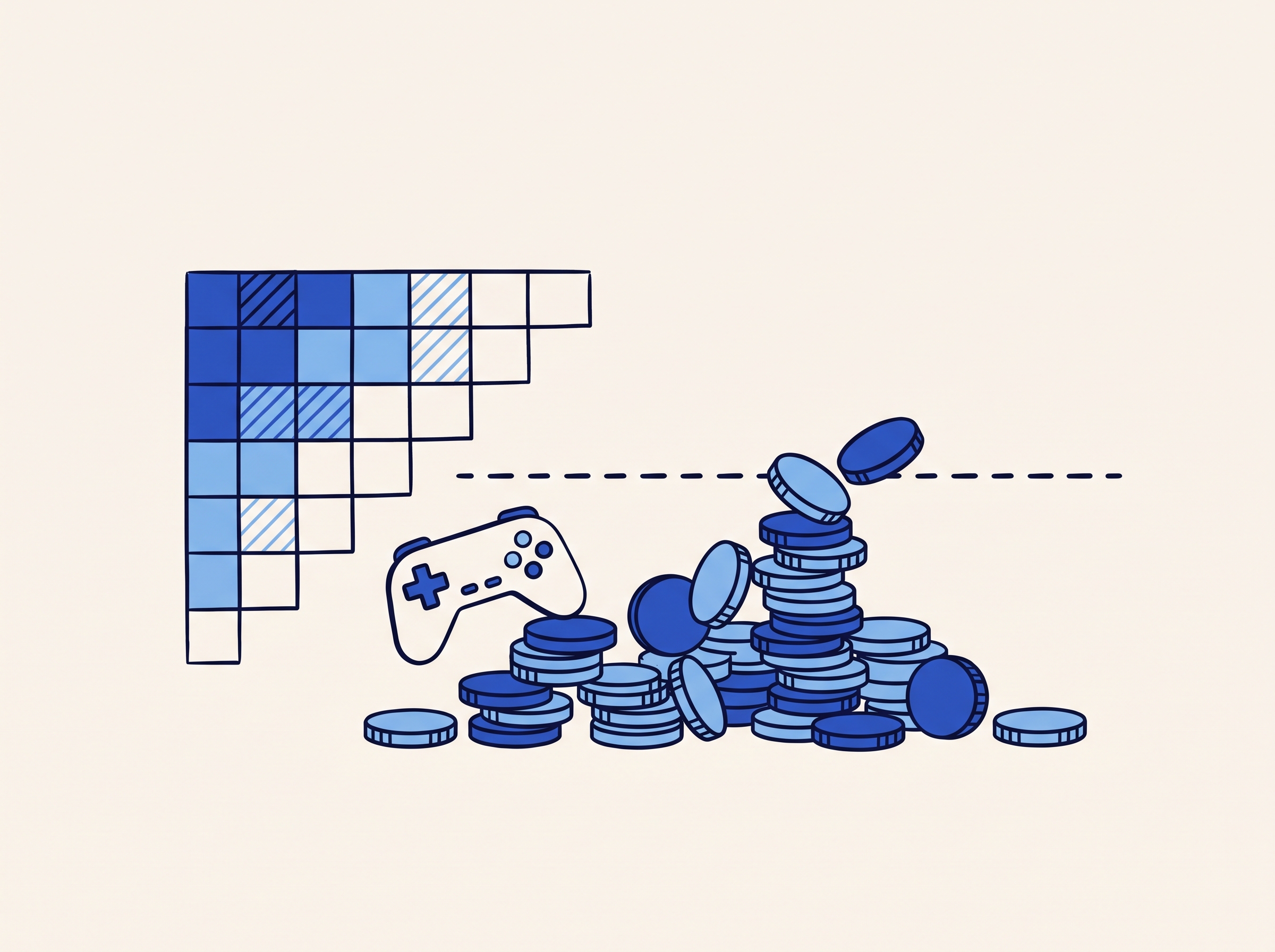
How to calculate mobile game payback period with one cohort
This sample is made for this article. It follows a fictional puzzle game campaign that started on one Monday. The campaign spent $12,000 and acquired 4,000 installs, so the campaign CPI was $3.00. Revenue below is cumulative net revenue from only those 4,000 installs.
The calculation uses two formulas:
cumulative ROAS = cumulative net revenue / campaign spend
payback day = first day where cumulative net revenue >= campaign spend
Do not divide campaign cost by all app revenue. The numerator and denominator have to describe the same acquisition cohort. If cost data arrives daily while revenue is delayed, mark the report as incomplete instead of filling the gap with an estimate.
| Age | Net revenue added | Cumulative net revenue | Cumulative ROAS | Payback status |
|---|---|---|---|---|
| D0 | $1,000 | $1,000 | 8.3% | Not paid back |
| D1 | $1,400 | $2,400 | 20.0% | Not paid back |
| D3 | $1,700 | $4,100 | 34.2% | Not paid back |
| D7 | $2,200 | $6,300 | 52.5% | Not paid back |
| D14 | $2,800 | $9,100 | 75.8% | Not paid back |
| D30 | $4,000 | $13,100 | 109.2% | Paid back |
The D7 calculation is $6,300 divided by $12,000, which equals 52.5%. The D14 calculation is $9,100 divided by $12,000, which equals 75.8%. At D30, $13,100 divided by $12,000 equals 109.2%. The cohort first clears its cost at D30, so the mobile game payback period is 30 days.
A percentage alone would not show that timing. A D30 ROAS of 109.2% looks positive, but it does not say whether the campaign crossed 100% at D15, D29, or D30. For cash planning, that difference matters.
Why net revenue changes the answer
Gross purchase value can make a cohort look paid back earlier than it really is. Pick one net revenue rule before reading the table. Apply it to every campaign, every country, and every cohort age. Changing it halfway through makes older and newer rows incomparable.
Ad revenue belongs in the calculation only when it can be attributed to the same cohort and is reported on the same timing basis as purchase revenue. If ad revenue arrives late, hold the cohort open and disclose the reporting lag. A tidy but incomplete D7 number is worse than a clearly provisional one.
The same discipline applies to subscription trials. Count a renewal when the chosen revenue definition recognizes it, then use that rule for every campaign. A report can track both gross and net views, but the budget decision should name which one it uses.

How to use mobile game payback period in a budget decision
Compare campaigns at the same cohort age. Do not compare one campaign at D30 with another at D7, even if the newer campaign has a higher current ROAS. The older cohort has had more time to monetize.
Consider two fictional campaigns for the same puzzle game. Campaign North spent $10,000 and reached $10,300 net revenue at D30. Campaign South spent $8,000 and reached $9,000 at D30. Both paid back by D30, but South returned $1,000 over cost while North returned $300. That does not automatically make South the better scale choice. Check whether South has enough volume, stable cost, and a similar country mix before moving budget.
| Campaign | Spend | D30 net revenue | D30 ROAS | Result |
|---|---|---|---|---|
| North | $10,000 | $10,300 | 103.0% | Paid back by D30 |
| South | $8,000 | $9,000 | 112.5% | Paid back by D30 |
Start with a modest budget shift, then watch the new cohorts. A campaign can change when budget, bid, creative, country mix, or conversion optimization changes. Treat a material change as a new comparison group rather than assuming its prior mobile game payback period will hold.
The cohort ROAS worked example explains the revenue-to-spend ratio underneath this view. Attribution quality comes first, too. The Google Play Install Referrer setup guide covers one Android signal used to connect an install to acquisition activity.
Four checks before trusting the result
- Use spend from the same campaigns, dates, countries, and platforms as the install cohort.
- Keep the revenue definition fixed, including refunds and any deduction applied before net revenue.
- Compare cohorts at the same age, such as D7 to D7 or D30 to D30.
- Label incomplete data when cost, revenue, or attribution is delayed.
A mobile game payback period should be one decision column beside volume, retention, and later cohort ROAS. Use it to protect cash while the game gathers enough cohort data for bigger budget choices.